Showing posts with label Ashtavinayaka. Show all posts

Sunday, 16 March 2014

Bhuleshwar: A Broken Beauty_March 16, 2014

It is hard to believe that a treasure of beautiful sculptures can be found at a distance of just about 50 kms from Pune. We decided to explore this place – for me, once again.

We started from Pune at about 8 am. We took the Pune-Solapur Highway (NH-9) via Swargate. After an awesome breakfast of Misal-Paav at Kaanchan (a Hotel just before the Bhuleshwar exit), we reached the temple. The temple is located about 10 kms off the Highway on a small hillock. This hillock is actually the Fort by the name Daulatmangal (formerly known as Mangalgad). Remnants of fort walls & bastions can be seen. The road up the fort is beautiful with excellent twists & turns. We went in hot summers; however, driving here in rains would be an experience to cherish.

The temple can be easily seen from a distance, with a telecommunication tower just behind it destroying the beauty of the place.

Reaching near the temple, a striking difference is seen as compared to other temples. Half the structure is made from Black Stone in a distinct Hemadpanthi Style while top portion, Shikhara, is of yellowish white coloured stone (seemed to be Standstone). More noticing is that the Shikhara is dome-shaped constructed in Islamic Style.

It is said that the temple was attacked by the then Mughal Rulers & destroyed. The Shikhara was completely destroyed. This was later reconstructed by the then Maratha Rulers. The extent of this destruction can be felt once you are inside. The entrance is hidden. It has steps on both sides to reach the top; the passage is narrow & dark. It is said to be constructed after the invasion to prevent any more.

A large Nandi meets your eye as you climb these steps. Sanctum Sanctorum with Shiva Linga inside is seen ahead of the Nandi. The Sanctorum is at the centre surrounded by the open-to-sky pathway around 3 sides; further surrounded by the pillared corridor. The entire area of the temple is a treat to watch. Intricately carved sculptures of Gods, Goddesses, Apsaras, Yakshas, Nymphs & Celestial Beings are present. These are carved around the Sactorum outer walls from bottom to top. The “differently colored & styled” Shikhara can be seen from here. There are sculptures over the top side of the corridor as well as on pillars.
Sandstone construction over Black Stone
Pillared Corridor surrounding the Sanctum Sanctorum
This Beauty is posing here since eternity

But the sad part is each statue bears the mark of hammers of its invaders; each sculpture is destroyed. The sculptures even in their destroyed form look beautiful. So one can imagine how it would have been looking centuries ago.
Sculptures adoring the walls of Sanctum Sanctorum

There are murals depicting stories from our epics like Ramayana & Mahabharata. I could identify the scene of Bharat-Bhet from Ramayana. One area on the top displays Lord Ganesh in Feminine form (Vinayaki Pratima). It can be easily identified because of its Trunk & a Mouse as carrier.
Mural depicting Bharat-Bhet from Ramayana
Vinayaki - Ganesha in Feminine form
I saw one dark room at the side. Actually nothing was visible inside. I just clicked a photo using a flash and this is what I could see. The sculpture has striking resemblance to Lord Vishnu resting on a Shesh-Naaga. Lord Vishnu’s form is not clear though.

While returning we decided to visit Theur. More info about this Ashtavinaya can be sought here, our previous trip.


Tuesday, 6 August 2013

Siddhivinayak of Siddhatek - July 21, 2013

It was the only Ashtavinayakas I haven't visited as yet; and hence was a long pending trip.

Ganesh idol of Siddhtek is the only one among other Ashtavinayakas with its trunk turned towards Right. Normally such Ganesh is called as Siddhivinayak - the giver of accomplishments - a powerful Lord but difficult to please.

Temple is located on a hillock along the banks of river Bhima. The devotees often perform the Prada-kshina (Circumambulation) around this hillock - similar to the one at Ganpati-pule. A well laid down path is constructed.

Legend says that while Lord Vishnu was battling two demons - Madhu & Kaitabh. However, he was not able to succeed. Later he invoked Lord Ganesha (the deity of beginning & obstacle removal) by performing penance at Siddhatek. After Ganesha bestowed his blessings, Lord Vishnu was able to kill those demons. The original temple is believed to have constructed by Lord Vishnu; however the current structure what we see is built by Ahilyadevi Holkar.

We started off at 7 am on this Sunday. We took the Pune-Solapur Highway (NH-9). Take an exit at Kurkumbh towards Daund. A flyover construction was going on. Hence this exit becomes slightly tricky. However, we seeked guidance of some locals and were rightly on track. Just prior to Daund, a road goes towards Right for Siddhatek.
We need to cross the river Bhima. Earlier there was no other option but a boat ride. But, now a bridge is constructed.
After crossing bridge, a hillock that we see in the front is the temple complex. You need to take a left and encircle the hillock on the other side, which is the entry. A large Nagaar-khana can be prominently seen.

A large banyan tree is seen at this entry. It's girth huge. It might have been standing here for years together.
The temple is North facing. A well paved road is seen from the Nagaar-khana to the Sabha-mandap with shops lined-up on both sides. Temple is made of black stone.

We found a very unique temple here. Exactly in front of the road coming from the bridge (i.e. the back-side of main temple). This Lord Vishnu temple is constructed at a platform about 10 feet in height. However, the funny part is that there are no steps to reach. Some stones are just kept over each other which you have to literally trek up the platform. We asked a local who told that the steps whenever constructed won't last at all. They get destroyed due to some reason or the other. Hence onwards, anyone who has reach the temple, they have to trek their way up. Secondly, the main entry door for the Sanctorum is very small. You need to squeeze yourself inside as seen in the photo below.


Main Temple seen from the high platform of Vishnu Temple
River Bhima seen from the high platform of Vishnu Temple
After a peaceful darshan, we decided to return. Since we had some time in hand before we reach Pune, we planned to visit another of the Ashtavinayaks - Theur.

On the way we had a lunch at one very interesting restaurant on the Kurkumbh-Daund Road.


We took same road back. Just after Uruli-Kanchan there is a road towards Right (towards Left while coming from Pune). This goes towards Theur.

This is the place that holds the memories of Madhavrao Peshwa and his wife Ramabai.

Theur is well-known to be the spiritual place for the Peshwas, especially Madhavrao Peshwa. He used to visit this Lord before & after his battle expeditions. He renovated the temple complex & made additions to the structure. He constructed wooden hall, garden & a fountain outside the temple. Behind the temple is the Peshwe-wada where Madhavrao used to stay.

He even chose to breathe his last here. When his health weakened due to tuberculosis, he decided to spend his last days near his favorite Ganesha temple. After his death, his wife Ramabai performed Sati during his cremation on the banks of River Bhima, not far from here.
Place where Ramabai performed Sati during cremation of Madhavrao Peshwa
The condition of this place is very depressing. However, some work seems to be going on here. Hopefully, whenever I visit next time, the place shall stand in the honor it deserves.
(16-Nov-13: Just today's newspaper has as article on this, the place has been restored & aptly renovated)

The temple has a wooden Sabha-mandap, I think the only one among Ashtavinayakas. The Ganesh idol is East facing, while the entry to the temple complex is North facing.

As per Puranas, there was this greedy King Gunasur who stole a wish-granding jewel (Chintamani) from a Sage Kapila. Kapila worships Lord Ganesha, who beheads Gunasur and gives Chintamani back to Kapila. However, the sage chooses to have Ganesha to keep the jewel. So Ganeshs stays at Theur with the name Chintamani.
Another story says that Lord Brahma meditated here. Lord Ganesha got rid of his worries (chintas) to help him meditate better. Hence the name Chintamani.

Both these temples are managed by the Chinchwad Devasthan Trust which governs the Moraya Gosawi Temple of Chinchwad.

Map:


Sunday, 16 December 2012

Ashtavinayak - Ballaleshwar of Pali - December 16, 2012

We decided to visit temple of Ballaleshwar (बल्लाळेश्वर), Lord Ganesh, at Pali (पाली) - one of the Ashtavinayakas (अष्टविनायक).

We left Pune at 7.15 am and took the Sinhagad Road to pick my in-laws on the way. We went through the Old Pune-Mumbai Highway (NH-4) and reached Khopoli (खोपोली). By 9.15 am, we were eating Batata Wada Sambaar at Ramakant.

From Khopoli we took a road towards Pen (पेण). After 4 kms there comes an over-bridge above Pune-Mumbai Express Highway. After crossing this bridge, take immediate Left towards Pali and Wakan (वाकण). Straight goes to Pen and Alibaag (अलिबाग).

By 10.30 am we reached Pali. This was my second visit here after our Alibaag trip 2 years ago. There is a car parking just opposite the temple entrance. It is a paid parking with charges of Rs. 20 per hour. There is one more free parking behind this one.

The temple as well as the town is situated just by the side of a massive fort Sarasgad (सरसगड). River Aamba (आंबा) also flows nearby. Actually we crossed the bridge on that river on the way.
Sarasgad
This is the only Ganesh amongst Ashtavinayakas which is named after his devotee Ballal (बल्लाळ). The story goes that there was a Brahmin boy named Ballal who was engrossed in the devotion to Lord Ganesh. He use to take his friends (other village kids) also along for the Ganesh Pooja. Villagers disapproved this act. Once his father caned Ballal and tied him to a tree in the forest while he was performing his Pooja. He also damaged the Ganesh Idol & left, leaving Ballal to die in that forest. At that time, Lord, impressed by Ballal's devotion, himself appeared before him and granted him a wish. Ballal wished that the Lord to remain in that village permanently. Ganesha obliged by staying there by the name of Ballaleshwar (Ballal's Lord).

This story is written there in another small temple just prior to the main temple - Dhundi-Vinayak Temple (धुन्डी-विनायक). There is a board written there, that this temple is to be visited before entering the main temple. Dhundi-Vinayak is the idol which Ballal used to worship and his father had destroyed.

Main Temple is about 50 feet away from here, made of black stone. It is said that this stone construction was done during the time of Peshwas. Earlier it was a wooden structure. Even the insides of the temple show some wooden structure (pillars and beams). There is one stone crusher (जाते in Marathi) kept outside which was used during that period to crush limestone for construction.

Lord Ganesh is East facing with Diamonds in its both eyes and naval. Outside the Main Sanctorum there is a Secondary Sanctorum which houses a Mouse (vehicle of the Lord) with a laddoo in its hands. Opposite these two Sanctorums is the Principal Hall having pillars on both sides with a large bell tied on thick chains. It was gifted by Chimaji Appa (चिमाजी अप्पा) - Military Commander of Peshwes, younger brother of Bajirao Peshwa (बाजीराव पेशवा). He had looted it from one of the Churches after his win over the Portuguese. Outside is a water body equivalent to a small lake.

After a satisfying Darshan, we left for Unhere (उन्हेरे) - place famous for its Hot Water Springs. From Pali we went ahead towards Waakan road. About 2 kms from here after a bridge on a river (supposed to be Aamba again) is a Right turn (info boards are available). 1 km from here is this Scientific & Natural Attraction. There are two stone constructed water baths (कुंड) over the water springs. One among them is covered, reserved for women.

The specialty is that the water is noticeably hot in these Kund. The temperature, they say, is in between 40 to 60 degree Celsius. This is due to the high Sulphur content in the water and its reaction with water salts. You can smell a different Sulphurous odour when you go nearby.

It is said that this water possesses medicinal value for curing skin diseases and allergies.

Only problem is that the water is stagnant. It is not a flowing water. Everybody just enters inside this common bath. This actually should be prevented. People should take the water out using a bucket and they should bathe outside. We actually saw a person sitting by the side and cleaning his teeth.

So I would recommend just to see this unbelievable place, dip your feet and witness the hotness of water and return, considering the unhygienic conditions here. Actually, I would not say this to be a "must seen" place. In case you visit Pali or a place nearby, you can see this place as it is just 3 kms from Pali and the visit will not cost you more than 15 mins of your time.

There is one Vitthal-Rakhmabai temple also between those two Kunds.

From here we decided to return back to Pune. We took the same route back.

We took a lunch stop at Lonavala at Hotel Gurukripa. Nice food, cheap. From here we went to see the Celebrations Wax Museum. Though I had seen it in last March, my In-Laws hadn't. This time I counted the statues - 35 in numbers. It was a nice refreshing second visit, because they had changed the arrangements and some interior renovations are made. I got to know additional information - the statues of Living people are made by taking their measurements while those of people who have died are made using photographs only. Secondly, these statues are made of 6 parts which are disassembled for cleaning and the clothes are changed once a month.

From here we returned back to Pune at 5.00 pm.


Odometer readings:
00 kms         Narayan Peth, Pune
78 kms         Lonavala (via Sinhagad Road and Bangalore-Mumbai Bypass road and then the Old Mumbai Highway)

91 kms         Khopoli exit after Khandala on common Express Highway & Old Mumbai Highway

96 kms         Hotel Ramakant, Khopoli
99 kms         LH turn towards Pali and Waakan; straight will go to Pen
140 kms       Pali
143 kms       Unhere

Return journey
181 kms       RH turn towards Khopoli; LH will go to Pen
185 kms       Khopoli
203 kms       Lonavala
206 kms       Wax Museum
280 kms       Narayan Peth, Pune


Thursday, 1 March 2012

Beautiful Bhandardara – February 25-26, 2012

This place, Bhandardara [भंडारदरा], was in my mind since 6 months now when one of my colleagues had visited it last monsoon. I had gathered the information about it and was waiting for an opportunity to explore the region.

And this opportunity came as part of a surprise to my wife on account of our wedding anniversary. I did the booking at MTDC last month and told her about the plan to celebrate this Anniversary Weekend somewhere outside Pune; however she was unaware of the venue (finally, I told her when we were 23 kms prior to Bhandardara).

We started off from Pune at 6.45 am and took the NH-50 (Pune-Nashik Highway). There are many routes to reach Bhandardara. The most common is from Sangamner [संगमनेर] and another one from Bota [बोटा] (just after Ale-Phata [आळे-फाटा]). There is one more (much longer) from Ale Phata and ahead of Malshej Ghat. All these routes are shown by Google Maps. However, I am not sure of the 3rd route from Malshej Ghat [माळ्शेज घाट].

I came across a much shorter route on one of the Team BHP blogs –
Pune-Narayangaon-Ozar-Otur-Brhmanwada-Kotul-Rajur-Shendi(Bhandardara).
The Route
This costed me about 176 kms (the shortest among other 3 routes mentioned above).

The drive was interesting. Small road turning through the fields on both sides, crossing over the hillocks through ghats. I enjoyed the drive. It was different than the mundane highway driving. It gave me the feeling of driving through the Western Ghats in Konkan.

Just after Narayangaon [नारायणगावा] on NH-50 there is a left turn to Ozar [ओझर] (Ashtavinayakas). We reached Ozar by 8.15 am. After a peaceful darshan of Vighneshwar [विघ्नेश्वर] and a breakfast, we cooched towards Otur [ओतूर]. At Otur we enquired for Brahman-wada [ब्राह्मण-वाडा]. The road goes straight ahead of Otur ST Stand.
Ojhar - Ashtavinayak

Ojhar - Ashtavinayak
At Brahman-wada, there is a “T” junction. Right will go back to NH-50 (Bota). We took Left. Then came Kotul [कोतुळ] and further ahead came Rajur [राजूर].

Ahead of Rajur there comes ascend towards left at Randha [रंधा] village (sign boards of MTDC and Anandvan resorts are available). This road goes to the village called Shendi [शेंडी] or Bhandardara.

Just before this ascend there is descend on Right towards Randha Waterfall. One can visit this before moving ahead. This will save your time of coming back again. Or else plan this while going back home.

Good amount of signage and boards are available for MTDC resort. The road goes through the Power Station, PWD Residential Colony, the Dam wall, Overflow gate, small bridges, etc. There are lots of Nilgiri Trees on both sides of roads. Large numbers of Bats are seen flocked on the branches of these trees all the day.

Sometimes in monsoon, the road near the overflow gate of the dam is completely under the water and hence is blocked. In this case, one needs to go straight ahead of Randha village (don’t take the Left ascent). Need to enquire to locals for the further way.

With 45 minutes break at Ozar we reached MTDC at 12.15 pm (4.45 hours / 176 kms).
We had booked Lake View Cottage. There were two rooms (a living room and a bedroom with attached toilet). Additional mattraces were available apart from a double bed and a sofa set in the living room.

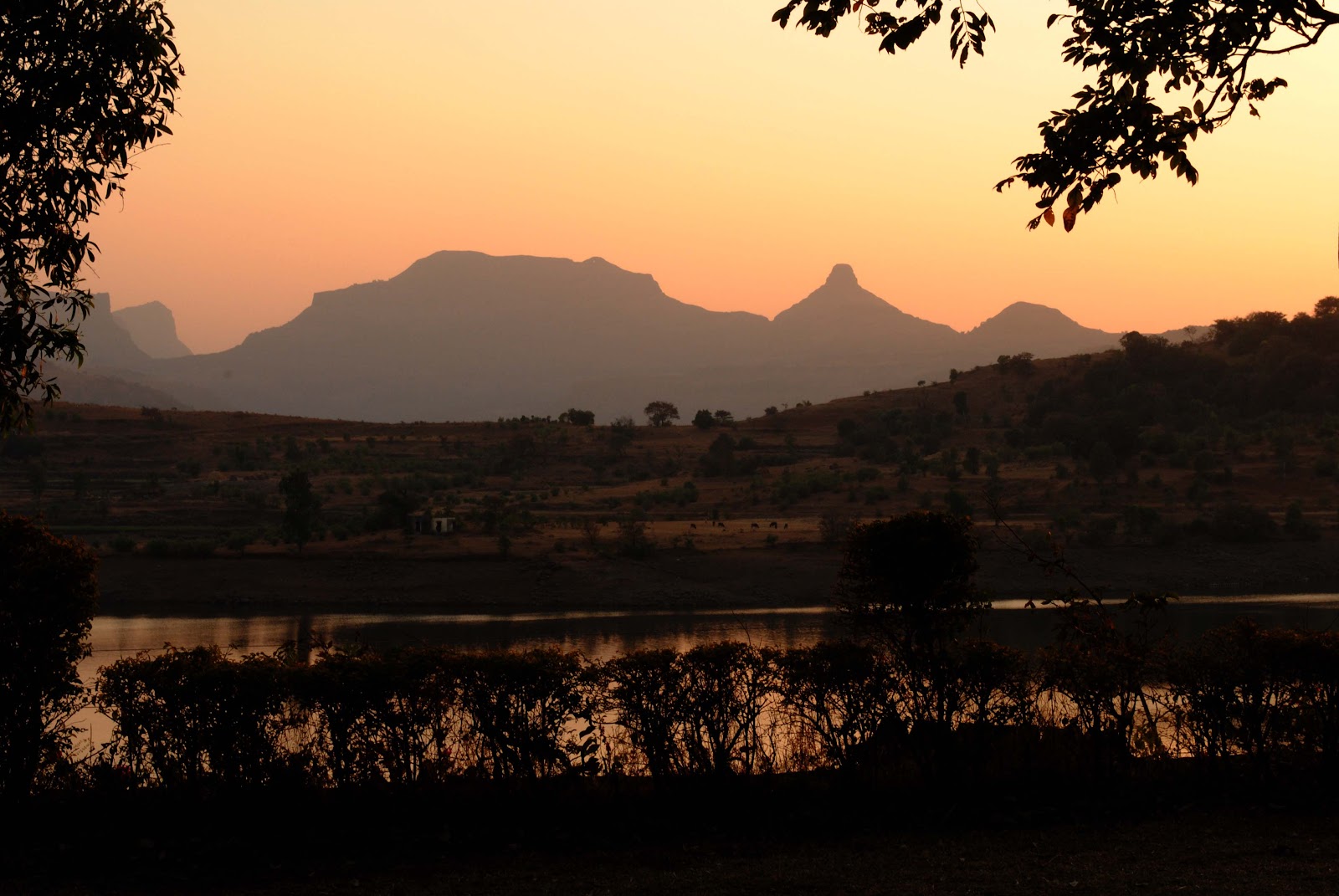
As the one at Ganpatipule and Malshej Ghat, this MTDC also scores for its location. Our cottage was just next to the lake. View from the verandah and the window was superb. I could see the beautiful lake in the front and complete Sahyadri Mountain Range at the background. I could see the fort Ratangad exactly opposite. In the evening we watched the Sun setting in front of us. 100 marks for the location. This view is not available to other resorts in the area (Yash Resort – 5000 Rs a day and Anandvan Resort – 10000 Rs a day).


The view:


It’s a no-frills place; basics only are available.
Room service is available with a 10% extra charge à Very bad!!!
Toilets were exceptionally clean.
Load shedding is a problem. When we reached our room, there was no electricity. Generator starts at 3.00 pm (???). Surprisingly, the ambient temperature was much cooler inside the room as compared to outside. At night we came to know that the fan is not working, tubelights have gone off. We complained, an electrician arrived, he tried to fix the problem; but in vain.
Food when we ordered in the afternoon was awesome (Veg Thali); however when we tried Punjabi Dish in the evening, it was pathetic. Breakfast (Omlet) and tea next morning was again – awesome.

I had heard that Guides are available near MTDC who take you around the place. We met one such person while checking in our room. I took his contact details.
After a brief nap in the afternoon, we called up that Guide – Vijay. We fixed up a rate of 400 Rs. for two days. There are two ways for sight-seeing – a short 22 kms to-and-fro for Wilson Dam, Arthur Lake, Over-flow Gate and Randha Falls AND a longer 55 kms to-and-fro around Bhandardara Dam catchment area (Arthur Lake).

We left at 4 pm for the shorter route first. We visited through the same route while coming from Pune some time back.

Wilson Dam: Named after a British Governor of the region. Built some time during 1910; construction took about 16 years to complete. It is built on Pravara [प्रवरा] River (also known as Amrutvahini in the region). The water catchment area is as wide as 25 kms and as deep as 260 feet.
Wilson Dam wall with Umbrella Falls on right
Umbrella Falls: When one of the sluice gates (on the Right side of the wall) is opened, the water that gushes out forms a shape of the Umbrella due to the shape of the rock below. Hence the name. It is visible in monsoons or when the dam gates are opened as per the irrigation requirements during the year. (our bad luck – the gates were opened just 2-3 days ago)

Arthur Lake: Named after the architect of the dam. It is the water body that is formed due to the catchment of Wilson Dam. Boating facilities are run by locals here. The sight of this lake surrounded by Sahyadri Mountains all around is mesmerizing.

Over-glow Gate: Little ahead of the Main Dam Wall, are the Over-flow Gates. These radial gates are used to maintain the required water levels. In monsoon, these gates are opened to its limit and still water overflows from the adjust walls passing through the bridge and road. This causes the blockage of road.

Randha Waterfall: Pravara River ahead of this dam descends roaring down into a beautiful gorge forming a Waterfall. Named after the village nearby. It is one of the leading waterfalls in India. It is available all-year-round. However the intensity in monsoons is magnanimous.

Honey-combs on rocks at Randha Falls; Tribals climb down
towards them to collect honey
By 6.00 pm, we reached our cottage. Watching the Sun set from your verandah is an awesome sight. Though the Sun sets everyday, you cannot witness it in your cities.

Next morning, we checked-out from MTDC at 9.00 am after our break-fast. We started off for the drive around the Bhandardara Dam. We again took the same road as yesterday till the Over-flow Gates. Then there is a Right towards Amruteshwar [अम्रुतेश्वर] Temple. This road comes under Forest Department surveillance. This is to avoid people from entering into hunting activities. One can find Rabbits, Foxes, Wolves and Leopards inside. Actually the area is the part of Kalsubai –Harishchandragad WildlifeSanctuary. There is charge of Rs. 50 per vehicle and Rs. 20 per person. However, if you visit the place before the schedule timing of the watchman’s arrival, you can visit inside without any ticket.

This drive is excellent. Small road turning in the forest covered with lush green trees; wheat fields were seen all around. Dried leaves were gushing behind due to speeding car wheels and watching this from rear view mirror of my car was priceless.
This road is around the lake with Sahyadris on to the left. We moved ahead of the village named Mutkhel [मुतखेल]. By 10 am, we reached the Amruteshwar Temple in the village of Ratanwadi [रतन-वाडी]. This is at the base of the fort Ratangad [रतन-गड].

Amruteshwar is the Shiva Temple built in Hemadpanthi style of architecture using black stone. It is about a century old. Some say that it is built in the era of Pandavas. References aside; the piece of art is awesome. Carvings inside and outside is beautiful. The black colored sculpture with a saffron flag flying on its top and the lush green back ground behind, makes this temple stand out as a Jewel in the area.

Amruteshwar Temple
Shiv-linga
Sculptures inside
This temple can also be reached through boat from Bhandardara. It’s about an hour’s ride and then a walk till the temple. This walk depends upon the water levels. We were told that we would need to walk about 3-4 kms (1 ½ hour) as the water levels are low.

Near the temple is the Jal-Kund [जल-कुंड] (Water Tank); again of black stone with carvings on it.

From here we moved ahead along the base of Ratangad. On our left was the grand fort of Maratha Empire while far away on right on other side the of lake I could see the tall peak of Kalsubai [कळसुबाई]. Leaving behind the village by the name Saamrad [साम्रद], we reached towards Kokan-Kada [कोकण-कडा] (not to be mistaken with the one on Harishchandragad [हरिश्चन्द्रगड]).
Ratangad
This is a place near Ghatghar [घाटघर] dam with no signs or boards around. It was the Guide with us hence we could trace it out. Else it is very difficult to identify the location. Locals might know about it; only there should be someone available to ask; we didn’t find anybody nearby.

This is place with “V” shaped rocks on both sides. Through which you can see a dam below – Chonda [चोन्दा] Dam. The view is beautiful; with strong winds flowing through.
The fun part is, the dam at the bottom is in Thane District. We were actually standing on the border of Ahmednagar District. Mumbai from here would be very close by. However, sadly, there is no road-route available yet.
Kokan-kada
From here, we moved ahead around the Ghatghar Dam walls towards Panjare [पांजरे] village. This is the base village for Mount Kalsubai. From here the Maharashtra’s tallest peak stands tall (1646 meters / 5500 feet above seal level) just next to you. You can see the red dot of the temple on the top of the peak.
Mount Kalsubai
From here we moved ahead towards our base camp, MTDC. We reached back by 11.30 am after completing a full circle of about 55 kms around Bhandardara Lake. Our route was Shendi-Mutkhel-Ratanwadi-Saamrad-Ghatghar-Panjare-Shendi.

When enquired at MTDC Canteen for lunch, it was not yet ready (lunch starts at 12). Nothing else was available to eat. We therefore had lunch at hotel nearby – Sonali. There is one more by the name Vaibhav. I had heard that these two serve good rice plates (Veg/Nonveg). Sonali was definitely good. But I felt it was costly at Rs. 70 per plate.

By 12.30 pm we started our way towards Pune. This time we decided to take the more busy and common Sangamner route. There is a Left just after Rajur towards Akole [अकोले]. This road meets the NH-50 (Pune-Nashik Highway) at Sangamner.

By 3.15 pm we were at Daulat drinking Watermelon Joice and by 6.30 pm, we were at the comforts of our home.

Coordinates of the place: 19° 33' 08.00" N   73° 45' 20.66" E


Odometer readings:

Day 1:-
0 kms     Pune (Narayan Peth)
13          Nashik Phata
24          1st Toll Point on NH-50 (Near Chakan)
43          2nd Toll Point on NH-50 (Near Rajgurunagar)
46          Rajgurunagar
66          Manchar
80          Narayangaon
91          Ozhar
100        Otur
116        Brahman-wada
133        Kotul
152        Rajur
166        Take the ascent on Left (look for boards of Anandvan and MTDC Resorts)
176        Shendi village (Bhandardara)
201        Sight-seeing at Bhandardara – Wilson Dam, Arthur Lake, Randha waterfall - total of 25 kms

Day 2 :-
257        Sight-seeing at Bhandardara – Amruteshwar temple (at Ratanwadi), Kokan-kada, Ghatghar dam, Kalsubai peak (base village) – 56 kms (around the Arthur lake)

281        Rajur
285        Take Left towards Akole, Sangamner
302        Akole
325        Sangamner
362        Daulat Restaurant (on NH-50)
476        Pune (Narayan Peth)