Bhushi Dam has become the busiest place near Pune during monsoons. And this is only from recent decade or so. The place is always in discussion for all the wrong reasons every year when monsoon visit this part of India - heavy rush, traffic jams, drunk public, accidents. It feels as if whole of Pune & Mumbai visit here as soon as it starts raining. Earlier it was not so. I remember having gone here without any rush about 15-20 years ago. After that I was always terrified of visiting here in fear of getting stuck in traffic. This year I thought of doing it in a unique way. We decided to leave early & return back before rush starts. Bhushi Dam actually is one of the oldest dams of the region. It was built on Indrayani river during 1860 for Railways. It was used as a water source for Steam Engines. Even today it is owned by Indian Railways.
As the water level rise, there is a under-cut in the dam-wall. Water starts overflowing & falls over 15-20 steps constructed on other side of the wall. The view is awesome & all these people mentioned above die-hard to get drenched here & enjoy.
We started at 6.30 in the morning from Pune. We took the old Pune-Mumbai Highway. We directly headed towards our destination as we didn't want to lose the congestion free time. With heavy heart with DID NOT STOP at Hotel Ramakrishna. Ahead of Ramkrishna, there is a left turn which goes over the Railway Flyover into Lonavala town. From here Bhushi Dam is about 5 kms. We reached the parking at 8 am.
There is heavy loot by the locals here. Car parking is charged Rs. 100. Toilet & Changing Rooms are charged for Rs. 10. Onion Pakodas were for Rs. 50. And you don't have any option. However, one thing was noteworthy - toilets were really clean & were worth 10 Rs. There is a brief walk of about 300 meters till the Dam Wall. Once at the steps, the enjoyment is extraordinary. When we reached, already 150-200 people were playing on the steps. It means so many of them had planned like we did & reached here early. They were just getting drenched in the white, gushing water and taking selfies. The locals were selling Vada-Pavs & Corn over the steps. Over-all the environment was jolly & picnic-mood. The water was crystal clear. We were able to see the bottom. Cleanilness around was so-so types. Mostly the tourists need to be blamed here.
We returned back by 9.15 am. By this time rush started to rise and we started our return journey. Now we could feel the traffic on opposite direction. Traffic Police were on job & they had started to regulate the traffic. At one point there were vehicle queued upto 500 meters. But this was for the on-coming lane. We were completely free. We had a breakfast at Lonavala & reached back home by 12 noon. So, our plan was successfull. We didn't stuck into traffic anywhere; we got good car parking location; no hurdles in taking out the car; there was no mad rush anywhere; and more importantly, there were no drunkards; there were only family groups.
This year seems to be most travelled – first to the Northernmost
part of India, Kashmir & then the Southern tip (well, almost), Kerala. If
one is the “Paradise On Earth”, then the other is no less, especially Munnar. That's why it is very rightfully referred as God's Own Country.
We had planned this trip almost a year in advance. We
finalized & did our ticketing 4 months ahead. Various options were on cards
– rarely known North Kerala & the South Kerala combo with Kanyakumari. We
finally decided for a more common Golden Quadrilateral of Central Kerala:
Cochin – Munnar – Thekkady – Kumarakom / Alleppy (Alappuzha).
We boarded our train, Pune – Ernakulam Poorna Express
(11097) on the night of December 19, 2015. The train passes through the
Doodhsagar Falls (in Karnataka) next morning. This is the one famous Falls
which features in the movie “Chennai Express”. We selected this train for the
same reason.
December 21, 2015:
On the 3rd day early morning at 3, we reached
Ernakulam Junction (25 minutes before time). Ernakulam is actually part of mainland
portion of the city of Cochin. Both are in a way, twin cities. We had booked a
Tempo Traveler for our further tour. We started for our onward journey by 4.30
am. Munnar is about 120 kms from Cochin / Ernakulam.
The initial part of the trip travels through the main Cochin
city, then the more urban area & finally entering into the twisting &
turning roads within lush green hills. Enroute is a 4 layered Cheeyappara
Waterfalls about 70 kms in the journey. After a tiring start to the day
(uncomfortable sleep in train, waking-up early morning, not enough breakfast),
this breathtaking Falls was a nice change. The waterfall is just by the road
side & cannot be missed. Just a kilometer ahead is another Water Fall –
Valera Falls. It is, however, on the other side of hill & has to be viewed
through a distance.
Cheeyappara Waterfalls
Within a couple of hours, I woke to the view of Tea
Plantations, a signature that we were finally in Munnar. One can view these
Plantations till the eye reaches the horizon. After a brief photo-stop on the road,
we reached our hotel at 10 am – Hotel Munnar – Terrace Greens.
Munnar
Munnar is one such scenic location which has a mix of
natural landscapes with man-made Tea Plantations. This combination makes up the
beauty. Visiting here & looking around, there was a feeling as if the view
here is no less than what I saw in Kashmir 6 months ago; except the snow was
missing on mountain ranges far away.
After some rest in the afternoon, we decided go out for some
adventure. Our driver suggested one such place – Kolukkumalai. It is one of the
best places to visit, if in Munnar. Kulukkumalai Top is the highest point in
the whole of South India. It is home to the highest tea plantations in the
world; with the tea grown here possessing a special flavour and freshness
because of the high altitude. It is situated on the border of Kerala &
Tamil Nadu (when on top, one side is Kerala while the other is TN). It is about
40 kms from Munnar main town. The road is a completely Kuttcha & has to be
accessed through the 4x4 Jeeps only. It costs about Rs. 1500 for a return
journey of Jeep (carries about 8-10 adults).
The experience & adventure is awesome. Passing through the bumpy ride watching the abundance of Munnar Magical Beauty was heavenly. Few water falls on the way were icing on the cake. As we started nearing the top, we could feel the Clouds around us. It was extremely chilly on the top. After watching a peaceful Sun-Set, we started for our return journey back to our hotel. Kolukkumalai for me was definitely a place to visit atleast once in lifetime.
If travelling through Packaged (Group) Tours, this place is
missed / not covered in their itinerary. Ensure you add it up & make sure
you won’t miss it.
December 22, 2015:
We started for our Munnar sight-seeing in the morning. Our
first destination was Mattupetty Dam. It is located just outside the main town
& has beautiful reservoir & water catchment area. The dam is built
mainly for Hydroelectric power generation. By the side is a market for local
goods, foods & spices. Just ahead of the dam along its reservoir is the
Echo Point. It is actually a spot by the water. Boating facilities are
available. The whole area is often visited by wild Elephants. Vehicular traffic
is not allowed after sun-set here.
Mattupetty Dam
We did some Elephant Rides on the way. It is fun, especially
for kids. We normally don’t get this experience. Apart from regular rides there
are some more activities (feeding elephants with fruits, rain shower).
After having stomach full Kerala Meals at Saravana Bhavan,
we went for a Kathakali & Kalaripayatu Show. Kerala, being a tourist place,
there many such Cultural Centers all over. They showcase their traditional
forms of art. They are surely worth a visit.
Kathakali is an Indian Classical Dance form of Kerala. Its
genre is Story-Play; even the name is broken down in Sanskrit as Katha (Story)
and Kala (Art). The distinctiveness of this art form is the colorful dressing,
elaborate make-up & characteristic face-mask. The dance constitutes hand
& facial gestures (Mudras & Navarasas). It is traditionally performed
by male artists (even the female roles are performed by men). However,
nowadays, women too take part in Kathakali performance. It is traditionally
structured around mythological stories of Ramayana, Mahabharata &
Bhagavat-purana.
The Kathakali show consists of atleast 2 artists (one doing
a female role), a Sutra-dhar (or story-teller) & musicians. Many hours
before actual show timings, artists are busy preparing themselves their
make-up. The show starts with explanation of all Mudras & Navarasas. Then
the actual story starts. In the end they offer the patrons to take a photo with
the artists. The show is definitely fascinating.
Further we waited for another master piece of Kerala –
Kalaripayattu. It is one of the oldest forms of Martial Art using techniques
& styles from Yoga, finger movements & dance. It is fought empty handed
as well as with weapons (swords, spears, knifes, etc.). The show consists of
individual performances as well as one-is-to-one & multiple combats. This
show was entertaining.
Our next plan was for Periyar Tiger Reserve. However,
reaching here we came to know there is an Online Booking that is required.
Visiting directly can be problematic if bookings get full.
December 23, 2015:
We checked-out from our Hotel and started for Thekkady. We
saw couple of wild elephants grazing far away on top.
On the way breaked at Spice Garden. There are many Spice
Gardens in part of India. The climate & soil being conducive to spices,
locals have developed their lands into Spice Gardens to attract tourists. They
conduct a guided tour where they take you around the garden; they show &
explain various spice plantations & their uses. The tour ends at the Spice
Shop which sells all those spices & ayurvedic medicines & oils. All
this has an entry fee of about Rs. 100 per person.
I felt that these Spice Gardens are good to have a break
& roam around. However, there is no need to buy spices from here; they are
available in towns at much cheaper rates. Ayurvedic Medicines can be purchased
as per requirement.
We reached Thekkady in the afternoon. Thekkady is an
important tourist place because of its proximity to Periyar Tiger Reserve. It
is also an heaven for Spices (Black Pepper, Cinnamon, Cardamom, Clove, etc.).
After a brief rest we ventured out for some Spices Shopping.
December 24, 2015:
In the morning, we started for the Periyar Tiger Reserve. It
is just 3 kms from Thekkady. After a check-point clearance, we entered inside.
Vehicles are allowed to a point after which there is a walk of about 300-400
meters in the dense forest with tall trees.
Periyar Tiger Reserve (or National Park or Wildlife
Sanctuary) surrounds the Periyar Lake, which was formed when Mullaperiyar Dam
was constructed in 1895. In other Wildlife Sanctuaries, normally Safaris are
conducted in vehicles (open Jeeps or mini-buses). This is unique in a way,
Safaris here happen in boats. The driver & the attendant show if any of the
animals are visible nearby. The area is a known Tiger Reserve & Elephant
Reserve; however, you need to be really lucky to see them here. And obviously
so, these are the special species & one should not expect them to be so
easily visible on a pleasure trip of one hour. Many species of birds are seen.
We were able to see the Sambars, Monkeys.
This one hour of boat ride was a different experience. I am
not sure where else you can roam around a Wildlife Sanctuary in a boat.
From here we started for Kumarakom. On the way, we hopped in
for a Tea Factory visit – Harrison Malayalam Ltd. Unfortunately, the factory
had a weekly off on Wednesday. Hence the tea processing was not in progress.
One of the employees accompanied us & showed us the processes through the
silent machines. In the end, we had some purchase of tea at their Factory Shop.
We reached our hotel in Kumarakom late evening by 8 pm. The
facility so far was the best in the journey. In the darkness of the night, we
were not aware about the location; but as we came out of our rooms in the
morning, we were just by the side of Vembanad Lake. The view was awe-inspiring.
December 25, 2015:
Sunrise - Vembanad Lake
Vembanad Lake is the longest lake in India (with 96.5 kms in
length). It is also among one of the largest lakes in India. It is situated
almost at the Sea Level, with some of its part below the MSL (Mean Sea Level).
It is separated from Arabian Sea by a narrow barrier island. The lake is fed
with 10 rivers and there is an intricate network of canals & lagoons. There
are number of villages in & around this Wetland System. These are connected
through this water network forming another Venice of East in India (another being at Srinagar).
Unique feature of this lake is the mixture of Fresh water
from rivers & Salt water from seas. Based on tidal action, the salt water
mixes up increasing the salinity & water level of lake during some parts of
the year. At other times, majority of it is a Fresh Water Lake. This ecosystem
has facilitated breeding of some special aquatic species in the lake.
Backwaters
Duck Farming
There are options of a stay in House Boat. The House Boat
roams around the lake, its canals & back-waters for the whole day with halt
at some point in the night. We however, decided to stay in a hotel & take a
small ride of couple of hours in a boat.
There is one Museum based on Fossils & Archeological
Discoveries in Kumarakom. But when we visited, it was closed because of
Christmas.
By afternoon, we left Kumarakom & reached Cochin (Kochi)
by 3 pm. We decided to visit few sight-seeing’s of Cochin. We reached the St. Francis
Church at Fort Kochi. Fort Kochi, by the way, is the region in Kochi one of the
old areas by the sea-shore.
St. Francis Church
St. Francis Church is the oldest Church in India – built in
1503. It was famous for one more reason. Vasco Da Gama died here in 1524; even
his body was buried in this Church. The remains were then carried back to Lisbon
14 years later. His Grave is still preserved inside the Church, apart from
graves of other Portuguese. The area around the Church is a local street market.
There is one play garden for kids & a walk-way by the sea-shore. The renowned
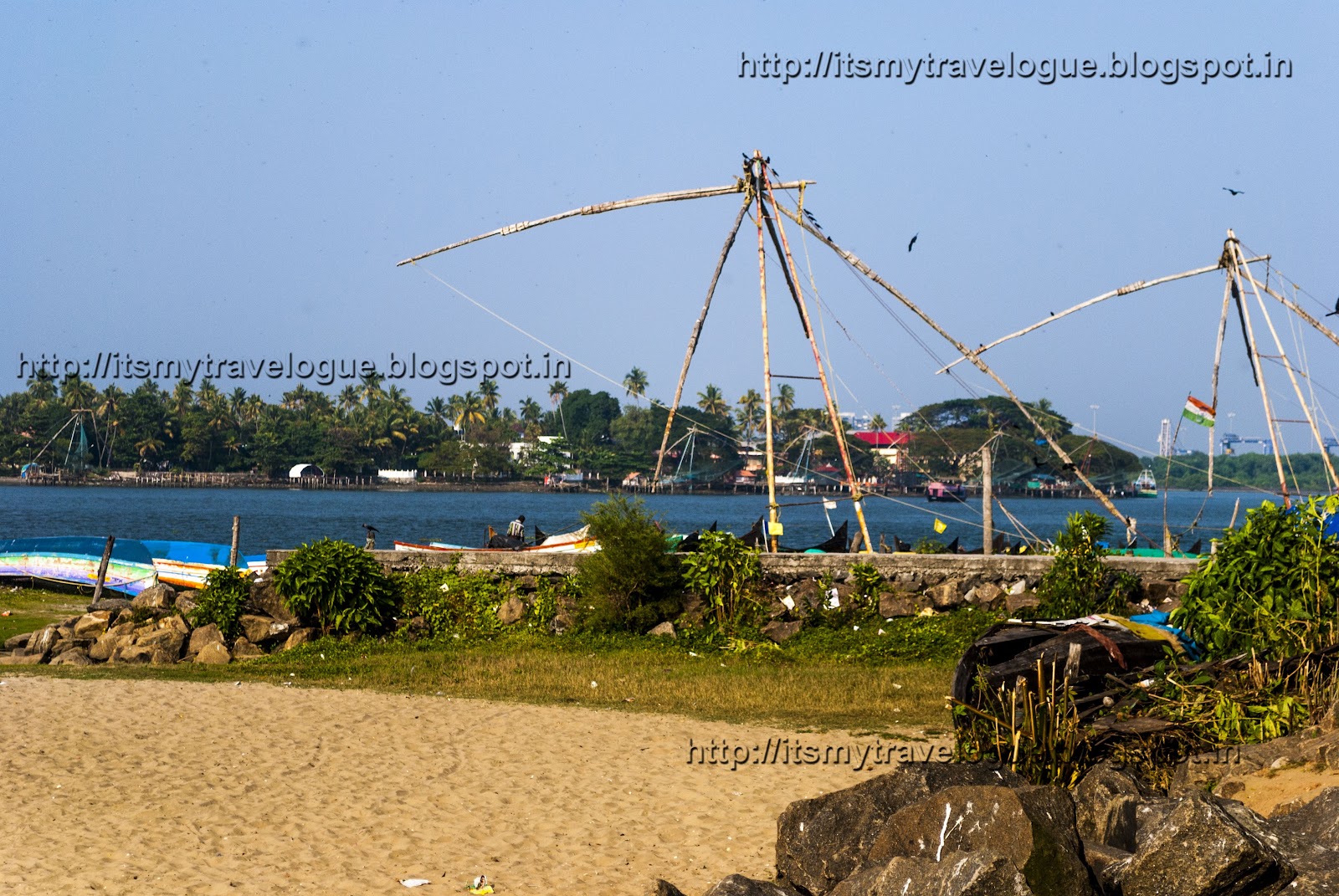
Chinese Fishing Nets can be seen lined-up by the shore.
Chinese Fishing Nets
From here we went to a place which we though we would hush-up in few minutes, but ended up in spending some quality time in admiration - Kerala Folklore Musuem. It has an exceptional collection of Art & Artefacts. Mostly focussed towards South India Culture. The artefacts range from Weapons, Utensils, Dresses, Idols, Props of various Dance Forms, Paintings, Photographs, masks, etc. Rs. 100 ticket is worth every penny. And more so that the Museum is not any Govt. Enterprise, but run individually by one, Mr. George.
Folklore Museum
We decided to spend the evening shopping in the market. However, being Chirstmas, the market was absolutely closed. We just, therefore, roamed on Marine Drive - the most happening place of Kochi. This promenade is an ideal place to spend some "self" time. Vast Arabian Sea on one side, modern malls & shopping complexes on other & the street vendors lined-up along. We spent about an hour here roaming.
Arabian Sea - view from Marine Drive
Further we checked-in our hotel for a final night of our trip.
December 26, 2015:
we had an evening flight. So we decided to munch another local place about 10 kms from our hotel - Hill Palace.
Hill Palace is another Archeological Museum managed by Govt. of Kerala. Originally it was built in 1865 by Maharaja of Cochin. Apart from Museum, it houses a Kids Park & Deer Park. It is built on a hillock which can be accessed by walk-way as well as simple steps. Vehicles are not allowed till top.
Deer Park
From here we bid farewell to the God's Own Country & proceeded for our return journey. Stay Details:
We had a "real" long Diwali Holidays to our Company - 9 days - long enough to make all others, JEALOUS ;-)
We colleagues decided to plan a one day trip after Diwali. Wai-Menavali-Dhom Dam was decided immediately. We started off from Padmavati in Pune in a Santro at 6.30 am. We took the NH-4 (Pune-Bangalore Highway) - the new road bypassing Katraj Ghat.
By 8.30 am we were having breakfast at the Wai exit on NH-4. Wai from here is about 13 kms. Road is single lane, graced by large banyan trees on both sides. However, traffic is seen for obvious reasons - Mahabaleshwar & Panchgani, the most sought after Hill Stations for people Maharashtrians & Gujaratis of this side. Just before, there is a diversion towards Right for Wai Town from the main Mahabaleshwar Road.
Wai (वाई) is famous for its Maha-Ganapati Temple on the banks of River Krishna (कृष्णा नदी). Also called as Dholya Ganapati (ढोल्या गणपती) considering the size of the idol. It is HUGE. Carved out of single black stone along with a large back rest. It is beautifully painted. Photography inside is not allowed. The temple was built in the year 1762.
Maha-Ganapati Temple of Wai - Dholya Ganapati
Next to the Ganesh Temple is the Shiva Temple - Kashi-Vishweshwar. It is said that the Nandi here is made out of same stone from which Shiv-Linga is made. By the side, some idols & a Shiv-Linga is kept in a make-shift area. These idols are actually from Ganakeshwar Temple, which got submerged below Dhom Dam (ढोम धरण) backwaters when the Dam was made operational.
Kashi-Vishweshwar Temple - Wai
But the beauty of this place lies 3 kms ahead. There is this place called Menavali (मेणवली) ahead on the same road from Wai. This is the place where Nana Phadnavis (नाना फडणवीस), one of the influential statesman of Peshwas (पेशवे), built a Wada (वाडा) on the banks of River Krishna. It's been 230 years since, that this place is still present to tell us the History. It must have been witness to many diplomatic discussion that Nana had while directing the affairs of Maratha Empire in the midst of internal disputes.
Next to this Wada, is a tree with a massive trunk. Just see the photo, how tiny a human looks in front of it. A platform is constructed around it. This tree & the parts of Wada were seen in the Hindi movie Swades - The Panchayat Scene.
Menavali - Nana Phadnavis Wada - Outsides
The Wada by itself is in a fairly good condition. Some areas are delapidated though. Descendants of Nana Phadnavis own this property, its items & the Ghat behind. There was family staying by the side; they might be the family of the watchman there.
We could go inside its compound. On the left we could see a large open square. Two storeyed structure is seen. On the right however, condition is not good. We could not enter the rooms. They open at 11.00 am. There are some old documents, antique items like wooden bed inside. The interiors of this Wada can be seen in the Hindi Movie Mrityudand. We had reached here at 9.45 am. Hence we decided to skip interiors this time. I would visit sometime later again.
Menavali - Nana Phadnavis Wada - Insides
Information Board - Nana Phadnavis Wada
Just behind the Wada is the most picturesque location of this entire trip. Menavali Ghat (घाट) on the banks of River Krishna. Stepping here, a film buff would start recollecting scenes from Hindi movies like - Entry Scene of Singham, Climax of Gangaajal, Bol Bachchan, etc.
Menavali Ghat (Krishna River)
There are two temples - one of Lord Vishnu & other of Meneshwar (Lord Shiva). There is a bell house in front of Meneshwar which has a large bell with carving of Mary holding baby Jesus in her arms. It is made of five-alloys & said to be of 650 kgs. It was captured by Chimaji Appa (brother of Bajirao Peshwe - I) from Portuguese in Vasai.
Ghanta-ghar
Meneshwar Mahadev Temple (with Ghanta-ghar - Bell House in front)
Meneshwar Mahadev - Shiv Linga
The Shiv-Linga is located about 5-6 steps below. There is complete dark out there. I was not able to see anything at all. Somewhere in mind was a fear; don't know what is there inside. It was that dark. Carrying a torch inside is requested. The photo above is taken blindly with just a camera flash. I tried 3 photos to get it right at the centre.
Climax of movie Gangaajal shot here
Village kids posing near two Nandis left there out of some film shooting
It was about 10.45 am when we left for Dhom Dam. Another 6-7 kms from Menavali starts the Dhom Dam wall. Need to pass ahead of Dhom village. But before the dam, there is another piece of our glorious history. Dhomeshwar Mahadev & Laxmi-Narasimha Temple.
Once reaching the road at the base of earthen dam wall, take a left and again a left to road that descends down within the trees. Signboards for Laxmi-Narasimha are available from Dhom village.
It is a complex that houses two temples - Dhomeshwar Temple said to be from the times of Paandavas AND Laxmi-Narasimha Temple built by the Peshwas.
Master Sculpture @ Dhomeshwar Mahadev Temple (Nandi on Tortoise back in a Lotus Pond)
There is one very different sculpture. Nandi in front of Shiva Temple is mounted on a Tortoise back. It's a huge tortoise over Lotus shaped pond. All this made out of black stone.
During one day in a year, the day Lord Narasimha appeared as per Shaastras, the pond is filled-up with water. At that time, it might appear as if the tortoise is swimming on water surface.
Dhomeshwar Mahadev
The main temple is intricately carved. It is built over a platform, need to climb 3-4 steps. Below the steps there is a small window, through which one can see a water cistern. The priest told us, it is actually a pond; the temple is built over a water body. Climbing the steps are three arches behind which is the Garbha-griha.
There is a Well beneath, opposite the temple (left side as you enter the main entrance - pictured above). Need to climb down 7-8 steps. Water from here flows out of a Go-mukh (गोमुख), about 30-50 meters away into a pond. However the area around that Go-mukh is not worth taking a photo even. Cleanliness drive of the water body is urgently required.
Dhomeshwar Mahadev - Temple Complex
Opposite Shiva Temple on Left is a circular construction. It is the Laxmi-Narasimha Temple, built by the Peshwas. Unique here is that there are two idols of Laxmi-Narasimha back-to-back. Narasimha here is in its two forms, with Goddess Laxmi sitting on his left thigh.
Laxmi-Narasimha Temple
One form is of Ugra Roop (Angry Form), with Hiranyakashyapu (हिरण्यकश्यपु) lying on his thighs & Narasimha tearing his stomach with bare hands. The other form is the Shanta Roop (Peaceful form).
Narasimha - Ugra Roop
Narasimha - Shanta Roop
There was another unique sculpture that I haven't seen anywhere yet. A Face Scuplture of Paandavas. Four faces are on the sides, facing outwards & fifth face is on top, facing the sky. Looking at it, I felt as if its our answer to the USAs Mount Rushmore in South Dakota. And how old is Mount Rushmore? Only about 90 years!!! (it was built just recently in 1925). ;-)
Face Sculpture - Paandavas (2 faces are at the back)
loved these colors
We turned back till the dam-wall road. Climbed a bit on the wall and view was breathtaking.
Panorama - Dhom Dam (Kamalgad at the centre)
Dhom Dam backwaters were in front of us with Kamalgad at the centre. I tried capturing the entire scene by 4 photo panorama above. Exactly behind me is Paandavgad.
Photographer in me awakens ... ;-)
It was hardly 12 noon. And our planned places had finished. Now we were discussing another possible place. There was Limb-sheri near Satara (Baara Motaachi Vihir), Kaas-Bamnoli, Thoseghar, Panchgani. We decided to go to Panchgani (पाचगणी), have something at Mapros, visit few Points, have a lunch & return. However, being Diwali holidays, there was mad rush. Heavy traffic jams in between. Mapros was jam-packed - inside and outside also. We dropped the idea & planned to go ahead to Mahabaleshwar. There was the same scene. Th road to Kates Point & Echo Point (which is really small) was packed due to traffic. We also dropped the idea of seeing any Points. We had a lunch at a hotel near Mahabaleshwar market. Had a small stroll in the market post-lunch. By the time we decided to leave, the rush had started to increase. So we decided to go ahead via Poladpur in Konkan on NH-17 instead of turning back all through traffic jams. On the way is Fort Pratapgad. Hence it got added in our itinerary. Pratapgad is that part of our history, for which each one of us are & should be proud of. It is a witness to the battle that was fought at its foot in the year 1659 - Battle of Pratapgad. Adilshah of Bijapur had sent Afzal Khan to lead an assault against Shivaji Maharaj in order to curb the growing Maratha threat. Shivaji at that time was at Pratapgad. Afzal Khan therefore moved his forces towards here. During peace-discussions between Shivaji & Afzal Khan, Khan made a life attempt on Shivaji. Shivaji was prepared for this & responded; killing Khan by a single stroke of Wagh-Nakhi. A battle erupted soon after ending with a decisive victory of Marathas over Adilshahi forces. Afzal Khan was burried as per Islamic customs & a tomb built at the foothills. This was Shivaji's philosophy - "Once the enemy is dead, enmity is dead too". This tomb was open to see earlier, but now due to a controversy, it is closed for tourists since past 7-8 years. We ascended the Ambenali Ghat (अंबेनळी घाट) which connects Mahabaleshwar with Poladpur on NH-17. In between is a way on left towards Pratapgad. Fort is accessible by road. Spacious parking is available. However, people visiting are in so large numbers (due to Mahabaleshwar nearby), that the parking falls short now. Mostly on holidays, cars have to be parked on the sides of narrow road, which creates more traffic problems.
किल्ले प्रतापगड
Fort from here is very easy to climb. Well-cut steps are there till the top. After the Main Entrance, comes the highlight of Pratapgad - Mahadwar Maachi or Afzal Maachi. Due to shortage of time, we could not see the entire fort. We went a little ahead to capture a snap of this Maachi & we turned back. Above this Maachi is the Citadel which houses a Bhavani Mata Temple, Life-size statue of Shivaji. There are many sites to see on the fort. All these on my next visit. Guides are also available who can take you around the fort with some information.
Mahadwar Maachi (Afzal Maachi) - Afzal Khan's Tomb can be seen on the right
We started our return journey from Pratapgad at around 5.15 pm. We went to Poladpur on NH-17 and joined the Varandha Ghat from Mahaad. Reached the NH-4 again at Kapurhol. We avoided traffic at Mahabaleshwar but landed in pathetic road on this Varandha route. We reached back in Pune at 9.30 pm. Odo Readings: 0 kms Padmavati, Pune 20 Khed Shivapur Toll 34 Kapurhole 71 Wai / Surur Phata (Exit) 84 Wai 88 Menavali 95 Dhom Dam 113 Panchgani 130 Mahabaleshwar 154 Pratapgad 180 Poladpur 193 Mahad 290 Khed Shivapur Toll 310 Padmavati, Pune